

 support@kratoman.eu


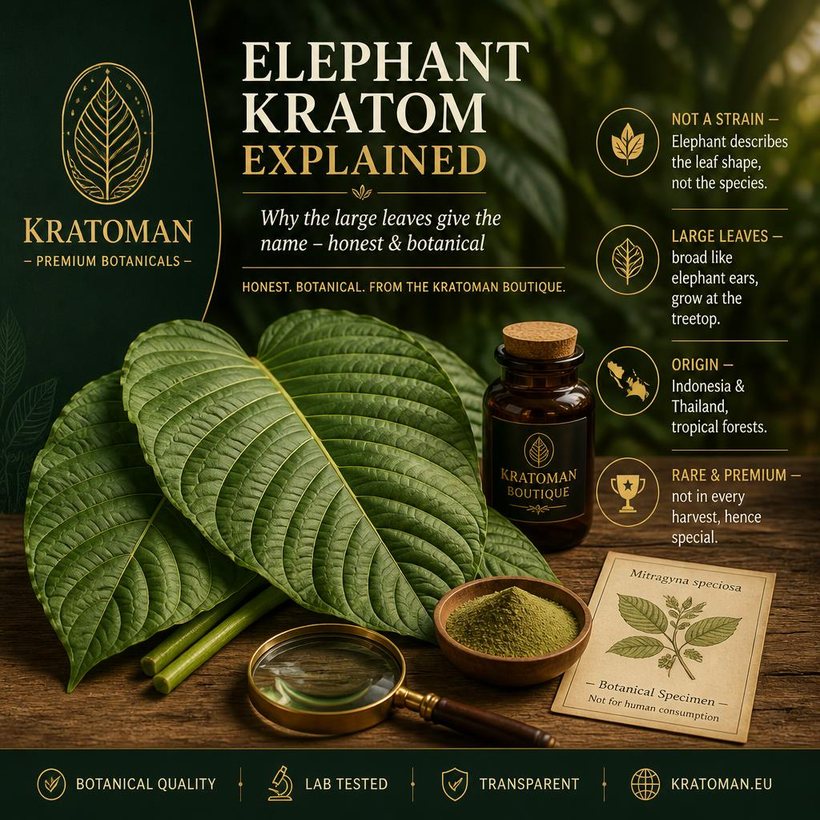
Where does the name „Elephant“ come from?
The name refers neither to a region nor to a vein colour, but simply to the shape and size of the leaves. Elephant leaves are particularly large, broad and slightly drooping – their silhouette recalls an elephant's ears. So „Elephant“ is a botanical description, not a strain or quality grade.
What makes the large leaves botanically special
The large, broad leaves typically grow at the top of the kratom tree. More leaf surface means more sunlight – and more sun gives the plant more energy, which can translate into a pronounced alkaloid profile. For how the alkaloid profile works in general, see our article „Understanding Kratom“.
Whether obtaining it is permitted at all is covered in our article on the legal status of kratom in Germany.
Origin: Indonesia & Thailand
Elephant Kratom comes from the tropical forests of Southeast Asia – above all from the remote regions of Indonesia (Borneo, Sumatra), but also from Thailand. As with every botanical specimen, soil, climate and harvesting tradition shape the result.
Elephant in colours: White, Green, Red
Like other varieties, Elephant comes in different colour expressions – the colour arises from ripeness and processing, not from different trees (more in our colour guide). In our boutique we carry two inspected Elephant specimens:
- Elephant Green – a broad-leaved green-vein specimen with a complex alkaloid structure and a soft leaf texture.
- Elephant White – a rare white-vein specimen from mature, broad-leaved trees, clear leaf structure and light colour.
How to spot quality (with COA)
From our practice – with Elephant (as with any botanical specimen) look for:
- Lab analysis (COA): alkaloid content, heavy metals and microbiological purity – where to find our COA documents is shown here.
- Traceable origin instead of anonymous bulk goods.
- Fresh aroma & even grind, light-protected vacuum packaging.
- Correct declaration as a botanical specimen – no health claims, no dosage.
For the legal side of kratom in Germany, see „Is Kratom Legal in Germany? (2026 status)“. And what „Maeng Da“ means is explained in our Maeng Da guide.
Frequently asked questions (FAQ)
What does Elephant mean in kratom?
The name describes the particularly large, broad leaves that resemble elephant ears. It is a botanical description, not a region and not a vein colour.
Is Elephant its own strain?
Elephant refers to the leaf shape. The colour (White, Green, Red) arises, as with other varieties, from ripeness and processing.
Where does Elephant Kratom come from?
Mainly from Indonesia (Borneo, Sumatra) and Thailand.
Discover more
Matching specimens: Elephant Green · Elephant White · Maeng Da Gold
Keep reading: Colour guide · Maeng Da · COA & lab analyses · Legal status 2026
Important note: All products on Kratoman.eu are offered strictly as botanical specimens for collection, research and incense purposes. They are not intended for human consumption. This article describes botanical characteristics only and makes no statements about any use or effect.

