

 support@kratoman.eu


Whether obtaining it is permitted at all is covered in our article on the legal status of kratom in Germany.
In short: the color lives in the leaf vein
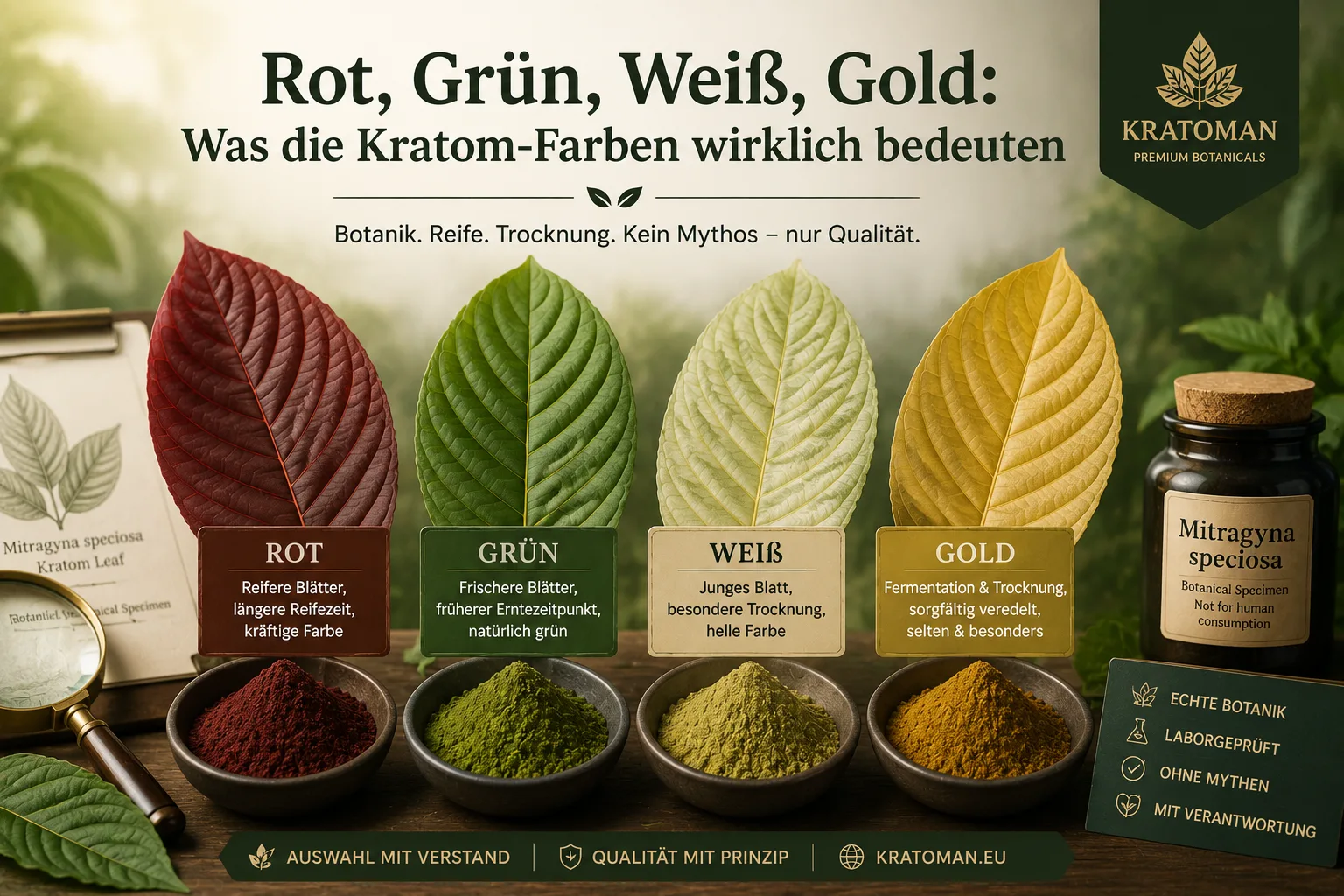
All varieties come from the very same tree – Mitragyna speciosa, botanically a relative of coffee (the madder family, Rubiaceae). ☕ So there is no "red" and no "white" kratom tree. 🌳 What sets the colors apart comes down to three things: the color of the leaf vein and stem, the ripeness of the leaf at harvest, and the drying method. These three factors shift the ratio of the 40-plus natural alkaloids (mitragynine above all) – and produce what collectors know as "color".
You can learn more about the plant itself in our Reading Room.
⚪ White – the young leaves
White varieties are made from rather young leaves with a pale vein and are gently dried, often without long light exposure. The result is a fine, light powder with a fresh, grassy-herbal aroma. In our range these include our Maeng Da White and the Elephant White – the latter named after its strikingly large leaves that resemble elephant ears. 🐘
Whether obtaining it is permitted at all is covered in our article on the legal status of kratom in Germany.
🟢 Green – the golden middle
Green is the all-rounder of the color box: harvested from leaves of medium ripeness, with a green vein. Aromatically it sits between white and red – many collectors start here because the profile is so balanced. For us it is the largest group: from the robust Maeng Da Green through Malaysia Green and Elephant Green to Super Green and Thai Green. If you want to understand the range within a single color, you will find it here. 🌿
🔴 Red – the mature leaves
Red comes from the ripest leaves with a reddish vein and usually goes through the longest drying – sometimes with a little sun or UV light, sometimes darkened in a fermentation-like way. This clearly shifts the alkaloid profile, and the powder turns darker and earthier in scent. Our representative of this family is the Thai Red – the "mature" side of our small collection.
🟡 Gold – not a tree, but craftsmanship
Here comes the most common misconception: gold is not a harvest color of its own. 😅 Gold varieties usually arise from a special processing or drying method (often from riper leaves, partly sun-dried, partly as a deliberate blend of white, green and red). So gold is less "what the tree does" and more "what people make of it" – craftsmanship, in other words. For us that title goes to the Maeng Da Gold, our premium piece for the collector's shelf. ✨
The colors at a glance
| Color | Leaf ripeness | Processing | Example at Kratoman |
|---|---|---|---|
| ⚪ White | Young leaves | Gently dried | Maeng Da White, Elephant White |
| 🟢 Green | Medium ripeness | Dried | Maeng Da Green, Malaysia Green |
| 🔴 Red | Ripest leaves | Longest drying / darkened | Thai Red |
| 🟡 Gold | Riper leaves / blend | Special processing | Maeng Da Gold |
Origin sometimes beats color: Borneo, Sumatra & Co.
A detail beginners often miss: the region of origin shapes the profile just as much as the color. Soils, climate and local harvesting traditions in Borneo, Sumatra or Malaysia create noticeably different "terroirs" – just like with wine or coffee. A Green from Malaysia and a Green from Borneo are simply not the same. By the way: because kratom is a pure natural product, the alkaloid content varies even within the same plantation – this is scientifically documented and a genuine mark of authenticity, not a flaw. That is why behind every variety at Kratoman there is a real origin, not anonymous bulk goods.
How to spot real quality
Color aside – what matters is the quality of the specimen. Look for:
- Lab analysis (COA): tested for alkaloid content, heavy metals and microbiological purity.
- Traceable origin instead of "somewhere in Asia".
- Fresh aroma & even grind – a musty smell points to ageing.
- Correct declaration as a botanical specimen – no health claims, no dosage.
And because many first ask whether all of this is even allowed: we cover the legal situation in detail in our Reading Room. 📑
Which color suits you as a collector?
There is no "best" – only what fits your collection. If you want to explore the range, start classically with a balanced Green, feel your way over a light White, and round it off with a mature Red. You will find the complete curated range in our kratom overview, and everything about ordering & shipping on the Purchase page. 📦
🌿 Discover all kratom varieties →
Frequently asked questions (FAQ)
Are red, green and white different plants?
No. They all come from the same tree, Mitragyna speciosa. The color results from the leaf vein, ripeness and drying.
What is gold kratom?
Gold is not a harvest color of its own, but the result of a special processing or drying method, usually from riper leaves or as a deliberate blend.
Which color is the best?
That is a matter of taste and depends on your collecting preferences. Aroma, color and origin differ – there is no "objective best".
Does origin matter?
Yes, clearly. The soil and climate of the region (e.g. Borneo, Sumatra, Malaysia) shape the profile much like "terroir" does for wine or coffee.
Is kratom legal in Germany?
In Germany kratom is not listed in the Narcotics Act (BtMG) or the New Psychoactive Substances Act (NpSG), but it is also not approved as food or medicine – a legal grey area. We offer everything strictly as a botanical collector's specimen.
💬 Questions about your choice? We help personally
Not sure which color or origin suits your collection? Write to us – we are happy to advise you directly and without fuss. You will find every way to reach us on our Contacts page, or quickly via WhatsApp and Telegram. Learn more about the idea behind our boutique under About us.
Important note: All products on Kratoman.eu are offered strictly as botanical specimens for collection, research and incense purposes. They are not intended for human consumption. This article describes botanical characteristics only (leaf vein, ripeness, origin, processing) and makes no statements about any use or effect. Please inform yourself about the current legal situation in your country.

